

The Best Fabrics for Suits
For most people, most of the time, the best fabric for suits is worsted wool. It breathes, holds a press, resists creasing and works across more of the year than almost anything else. Linen makes considerably more sense in high summer; flannel and heavier woollens earn their keep when the temperature drops; and black tie can call for cloth with a little more lustre and ceremony.
Rather than getting lost among hundreds of swatches, consider four things: fibre, fineness, weight and weave. Together, they determine how a cloth feels, drapes, travels, ages and responds to the weather.
In this guide we cover:
THE CLOTHS AND WHAT EACH ONE DOES
WHAT SUPER NUMBERS ACTUALLY MEAN
WEIGHT, WEAVE AND DRAPE
WHAT TO WEAR IN AN AUSTRALIAN YEAR
WHERE WE SOURCE OUR CLOTH

The Cloths and What Each One Does
Worsted Wool
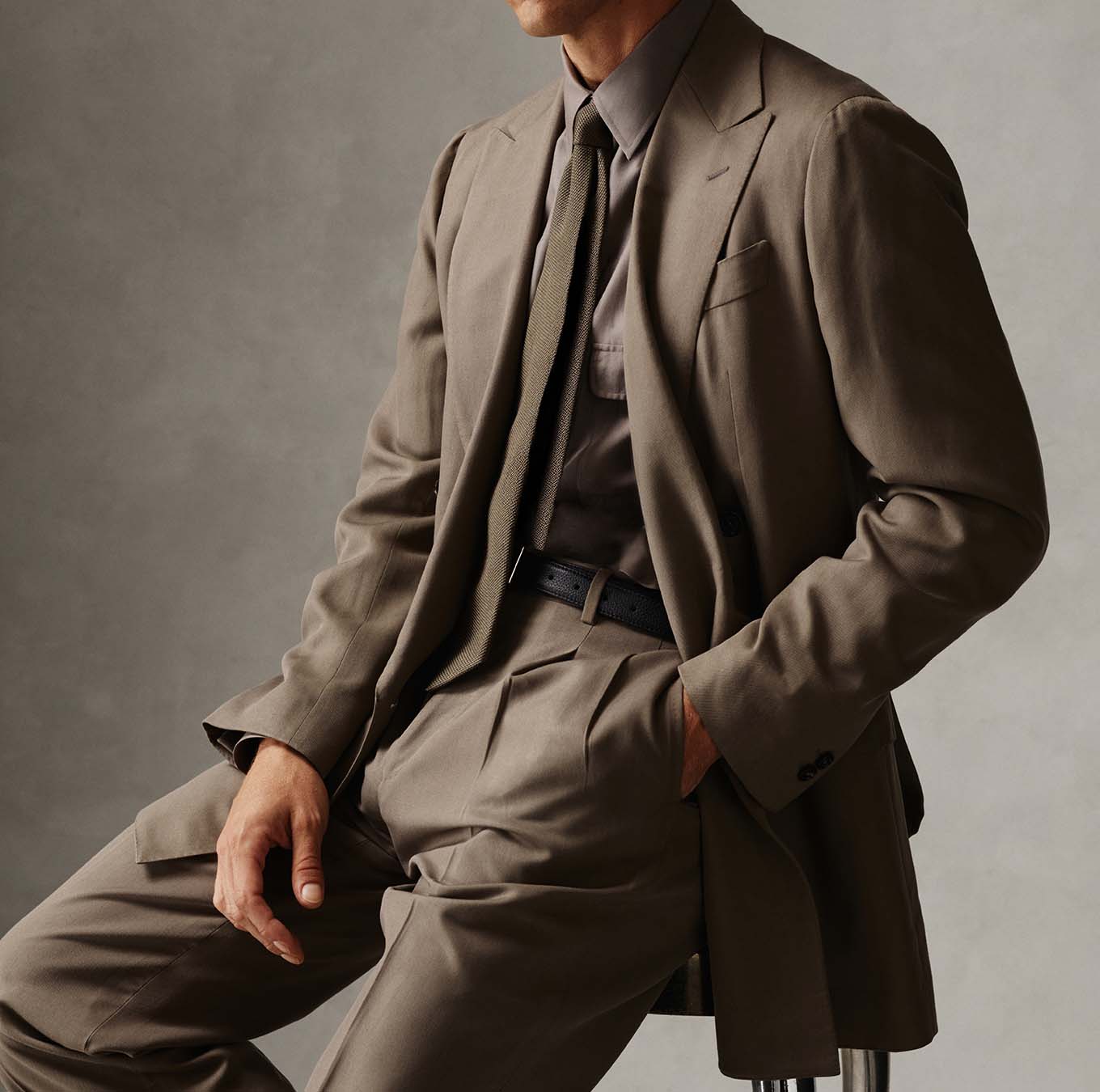
Worsted wool is the great all-rounder. Its smooth surface, natural breathability and ability to recover from wear make it equally useful for business, weddings and the suit you reach for without thinking too hard. It can be woven light or substantial, crisp or soft, which is why wool covers so much territory.
Wear this when: you want one dependable suit to do most things well.
Flannel
Flannel takes wool somewhere softer and more relaxed. Its brushed surface gives it warmth and depth, while the extra body creates a pleasing drape through jackets and trousers. It feels particularly at home in charcoal, grey, brown and other colours that benefit from a little texture.
Wear this when: Melbourne has remembered it’s winter and a lightweight worsted suddenly feels optimistic.
Linen
Linen is difficult to beat in genuine heat. It breathes beautifully, feels dry against the body and has a relaxed character that suits Australian summer dressing. And yes, it creases. That isn't a flaw to engineer away; the rumpling is part of linen's charm and the reason it rarely looks overly studied.
Wear this when: The wedding is outdoors, the forecast begins with a three, and formality needs some air.
Cotton
Cotton sits comfortably between tailoring and casual clothing. It tends to feel less formal than wool suiting fabric, developing character through wear rather than maintaining the polished surface of a business suit. It works especially well for separate jackets and trousers where ease is more important than ceremony.
Wear this when: A wool suit would feel like too much, but jeans would feel like too little.
Cashmere and cashmere blends
Cashmere brings extraordinary softness and richness to tailoring, particularly when blended with wool. The trade-off is durability: exceptionally soft fibres generally demand more care and aren’t a sensible choice for a suit being worn several times a week. Luxury and hard labour are not always natural companions.
Wear this when: Pleasure matters more than putting the garment through the daily commute.
Tweed and heavier woollens
Tweed and heavier woollens offer warmth, texture and a stronger silhouette. Their extra weight can give a jacket tremendous presence and tends to reward cooler weather. They are less universal in an Australian wardrobe, but in the right city and season that specificity is precisely their appeal.
Wear this when: The temperature properly drops, and you want the cloth to look as substantial as it feels.
Silk and silk blends
Silk is generally most interesting in tailoring when it has company. Blended with wool or linen, it can introduce lustre, softness and a slightly richer surface without turning the garment theatrical. It has a natural place in eveningwear, special-occasion tailoring and cloths where visual depth is part of the point.
Wear this when: Dinner starts after dark, and the cloth is allowed to catch a little light.
Camel hair
Camel hair belongs primarily to outerwear rather than everyday suiting. P. Johnson carries baby Bactrian camel hair for custom overcoating, alongside wool, cashmere and blends. It is beautifully soft and warm, with a distinctive handle that makes rather more sense as a coat designed for decades than as another navy suit.
Wear this when: Winter calls for a proper overcoat, and you’d like it to be something uncommon.
What Super Numbers Actually Mean
A Super number can sound suspiciously like a score. It isn’t.
In wool suiting fabric, Super numbers describe the fineness of the wool fibre according to an established classification system. Broadly, the higher the number, the finer the fibres used to meet that classification. This can produce a cloth with an exceptionally soft, smooth and luxurious handle.
What it doesn’t mean is that Super 150s is automatically ‘better’ than Super 120s. In fact, for plenty of wardrobes, the opposite is true. Very fine wool tends to be more delicate. A beautiful Super 150s cloth may be exactly right for a suit worn to important dinners and occasions, but a poor choice for something expected to survive trains, office chairs, flights and two wears a week.
For many people, the useful middle ground sits somewhere around Super 110s–130s: fine enough to feel elegant, but practical enough to enjoy without treating the suit as an exhibit. The question you need to be asking, then, isn’t: What is the highest Super number? It is: How often am I going to wear this suit? A fitter who knows the answer to that can steer you towards cloth you’ll still be pleased with after the novelty of its first touch has worn off.
Super 80s–100s
- What it feels like
- Robust, firmer and substantial
- Suitable for
- Frequent wear, travel and hard-working business suits
- The trade-off
- Less exceptionally soft to the touch
Super 110s–130s
- What it feels like
- Smooth, refined and comfortable
- Suitable for
- Versatile tailoring and regular business or occasion wear
- The trade-off
- Finer cloth still benefits from sensible rotation
Super 140s–150s
- What it feels like
- Very fine, soft and luxurious
- Suitable for
- Special suits and garments worn less frequently
- The trade-off
- More delicate and less forgiving of heavy wear
Above Super 150s
- What it feels like
- Exceptionally fine and soft
- Suitable for
- Rarefied occasion tailoring
- The trade-off
- Delicacy increases considerably
WEIGHT, WEAVE AND WHY A SUIT DRAPES THE WAY IT DOES
Two wool cloths can contain essentially the same fibre and behave entirely differently. Weight and weave explain much of the difference.
WEIGHT
Fabric weight is generally expressed in grams per square metre. As a broad guide, lighter cloths are useful for warm weather and travel, mid-weight cloths cover the greatest portion of the Australian year, and heavier cloths provide greater warmth, body and structure.
The temptation in Australia is to assume lighter is always better. Not necessarily. A little weight helps trousers hang cleanly, gives a jacket better drape and can improve durability. An extremely light business suit fabric may feel terrific on a hot afternoon but show wear sooner if asked to work five days a week.
Think about where the suit will spend most of its life, rather than choosing solely for the hottest day it might encounter.
WEAVE
Weave changes the surface, breathability and character of the cloth. Plain weaves are clean and straightforward, while Panama weaves have a more open structure that can help air circulate. Twill has a subtle diagonal line and tends to drape smoothly. Hopsack is open and textured, making it particularly useful for breathable jackets.
Herringbone creates its familiar broken zigzag and brings quiet pattern to otherwise restrained cloth. Birdseye uses tiny contrasting dots to give a solid colour greater depth from nearby. Flannel has a soft, brushed finish rather than the crisp surface of a traditional worsted.
You don’t need to learn the vocabulary before an appointment. Run a hand across the cloth, hold it up and see what it does. Much of the decision becomes considerably easier from there.
WHAT TO WEAR IN AN AUSTRALIAN YEAR
Australia does tend to complicate the traditional four-season approach to tailoring. A Melbourne July, a Brisbane February and a spring afternoon in Sydney have little business being treated as the same climate. The useful wardrobe responds to where you actually live.Australian tailoring needn’t pretend winter lasts six months. Choose for the life and climate the garment will actually encounter.
Melbourne winter
- What works
- Flannel, heavier worsted wool, tweed and textured woollens
- What to avoid
- Very light tropical cloth that offers little warmth
Sydney or Brisbane summer
- What works
- Lightweight high-twist wool, open weaves and linen
- What to avoid
- Heavy flannel and dense woollens
Humid conditions
- What works
- Breathable wool, linen and open-weave cloth with lighter construction
- What to avoid
- Cloth chosen for softness alone without considering airflow
Autumn and spring
- What works
- Mid-weight worsted wool and versatile wool blends
- What to avoid
- Over-specialising for either extreme
Summer wedding outdoors
- What works
- Linen, lightweight wool or airy wool-linen blends
- What to avoid
- Heavy, delicate cloth that becomes a burden by lunchtime
Year-round office wear
- What works
- Durable mid-weight worsted wool with good recovery
- What to avoid
- Extremely fine wool intended for occasional wear
Travel
- What works
- Wool with resilience and crease recovery; textured cloths that forgive a suitcase
- What to avoid
- Very delicate fibres and anything demanding constant pressing
A January wedding in Perth is not the moment to discover that the beautiful heavy cloth chosen in an air-conditioned showroom has its own weather system. For a warm-weather wedding, breathability and weight deserve as much consideration as colour.
Likewise, year-round office tailoring benefits from moderation. A good worsted wool can move from air-conditioned interiors to the street, recover overnight and return the next morning without complaint. If you travel regularly, resilience becomes even more important: a slightly textured or high-twist cloth will often emerge from a suitcase with considerably more dignity than something extraordinarily fine.
WHERE OUR CLOTH COMES FROM
P. Johnson carries European, British and Japanese cloths, including Australian superfine merino woven by specialist mills in the Biella region of northern Italy. Linens range from classic Irish cloth to softer Belgian and very light Italian options, while cottons come from specialist northern Italian and Japanese weavers.
For Pronto tailoring, lengths of Italian, British and Japanese milled fabrics are held on site, with further cut-lengths available from European weavers. Sartoria K cloths are sourced as individual cut-lengths from Italy, the UK and Japan.
Among the names currently represented are:
Loro Piana
- Location
- Italy
- Known for
- Fine wool, cashmere and luxury natural-fibre cloths
Scabal
- Location
- UK & Belgium
- Known for
- Fine luxury suiting and an extensive cloth collection
Vitale Barberis Canonico
- Location
- Italy
- Known for
- Classic Biella wool suiting across a broad range of weights and finishes
Drapers
- Location
- Italy
- Known for
- Italian tailoring cloth across formal, business and seasonal collections
Reda
- Location
- Italy
- Known for
- Fine merino wool and versatile contemporary suiting
There is pleasure in knowing where a cloth came from, but the name on the bunch isn’t a shortcut to choosing well. A respected mill tells you something about provenance, consistency, weaving and finishing. It doesn’t tell you whether that particular cloth belongs on your back in Brisbane in January.
The better decision begins with purpose: where you’ll wear the garment, how often, in what weather and how you’d like it to feel. Mill comes after that.
HOW CLOTH AFFECTS WHAT YOU PAY
Cloth is one of the biggest variables in the final cost of a custom suit. The chosen level of construction establishes the starting point; fibre, mill, fineness, rarity and cloth selection can move the investment from there. The most expensive option is not automatically the most useful one. See what a custom suit costs and how construction and cloth work together.
COME AND FEEL IT
Cloth is the part of tailoring that a screen cannot really capture. Weight, softness, texture and drape make considerably more sense between your fingers than they do in a photograph. Explore P. Johnson tailoring, or book an appointment at your nearest showroom and spend some time with the cloth books.
LEARN MORE ABOUT MADE-TO-MEASURE


READY TO START?
No obligation. No pressure. Just a conversation about what you're looking for.